Commercial Roofing in Roeland Park, KS
Food-service and retail roofs in Roeland Park, KS carry a maintenance load that a plain office roof does not, and the owner who plans for it sets the next replacement window with fewer surprises. Census QuickFacts reports 2022 retail sales of $202,074 thousand for Roeland Park and accommodation and food-services sales of $4,854 thousand, in a city with a 2025 estimate of 6,683 residents. Those figures show that shops and eating places are part of the city's commercial mix, so we plan for the roof conditions such uses tend to create: exhaust discharge, grease residue, heavy rooftop equipment, and tenants who cannot lose a day of trade to a roof problem.
Tell us what the roof carries and when it must be settled
Send the roof plan, equipment and exhaust locations, leak history, any warranty paperwork and your decision date for the Roeland Park building. We will return a documented assessment that keeps current repairs separate from capital planning assumptions.
Exhaust, grease and the membrane surface
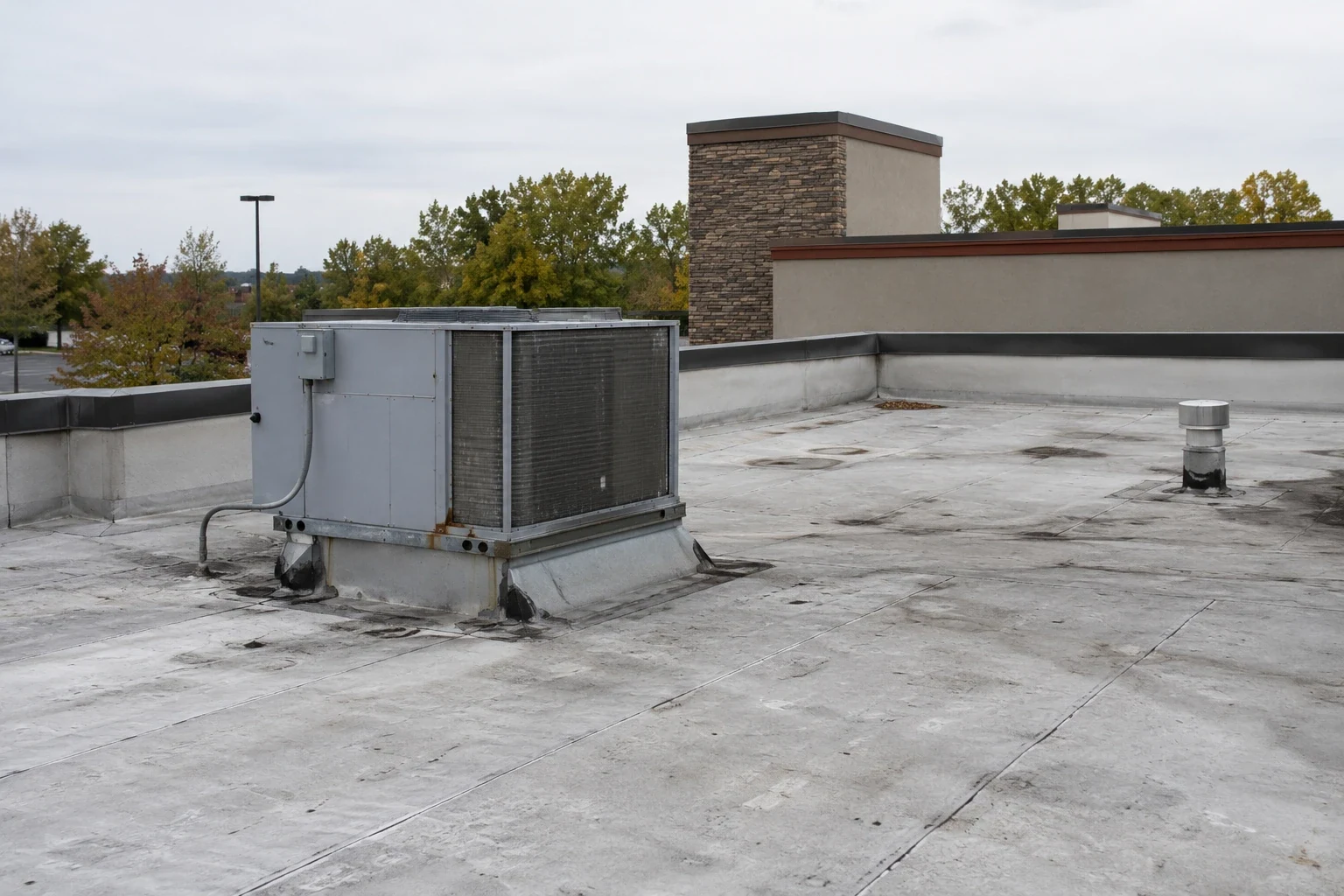
A kitchen exhaust fan discharges warm, fatty air onto the roof near the fan, and over months that residue settles on the membrane. Some membrane materials tolerate it better than others, and every one of them is easier to clean and inspect when a grease containment pan and a curb are properly detailed. We check whether the surface near an exhaust unit is softened, stained or blistered, whether the walkway pad is intact, and whether the flashing at the curb is still bonded.
Where fat and oil have degraded a membrane, the repair may be a localized replacement with a compatible material, a change in the exhaust containment, or a plan to move the work into the next capital year. Our restaurant roofing scopes account for these conditions, and each finding goes into the roof-area register with a photograph so the next visit can compare it.
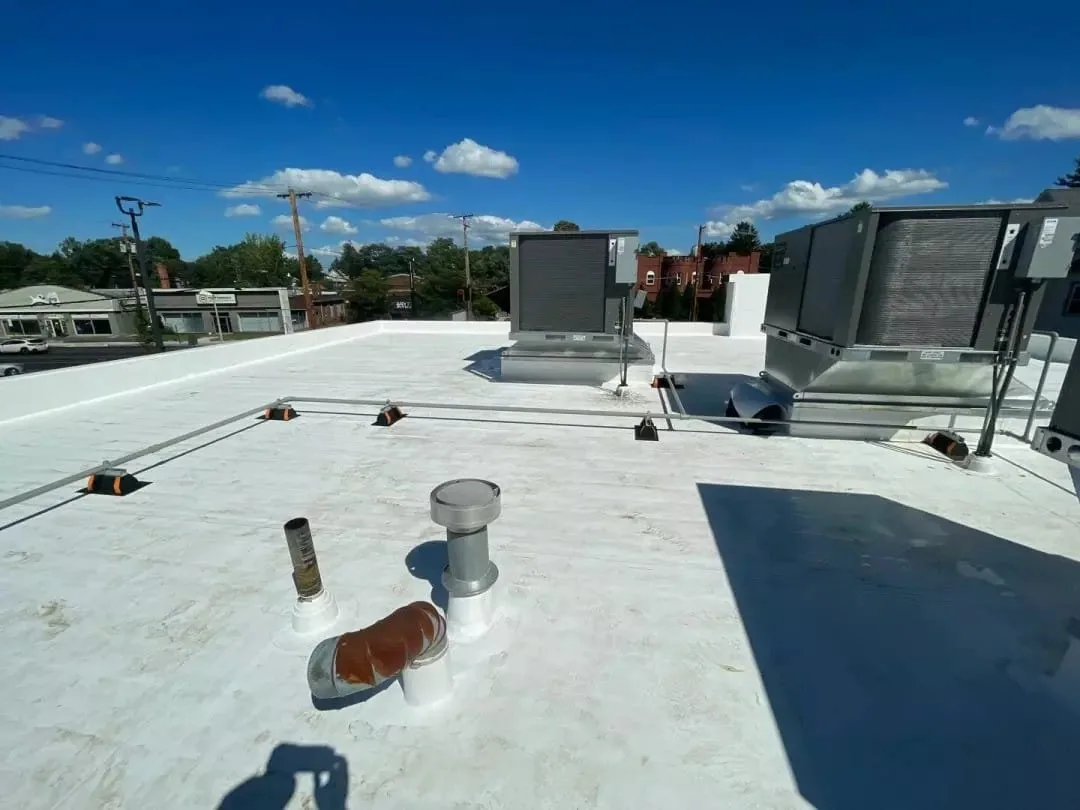
Equipment weight is the second concern near a kitchen. Exhaust fans, make-up air units and refrigeration condensers sit on curbs or rails, and service technicians walk the same short routes every week. We look for ruts in the membrane, loose walkway pads and rails that rest directly on the roof surface. Adding protection pads along those routes, and lifting supports on properly flashed sleepers, costs little beside a repair to a membrane that has been worn through at a single step.
Walls, parapets and the joints that open first
A small commercial building with parapets and rooftop walls has a high ratio of wall to roof, which means many wall-to-roof joints for each square foot of membrane. Base flashing that has shrunk, counterflashing that has pulled out of its reglet, and parapet caps with open joints are common entry points. These details move with temperature, and the nearest climate record, at the Olathe airport, runs between a 29.8°F January and a 78.8°F July, a seasonal swing that stresses every joint over time.
We probe these joints, check sealant adhesion, and look for staining on the wall below that suggests water has been entering for some time. A repair at the wall can be limited and inexpensive when done early. Left alone, the same joint can saturate insulation along the perimeter. Where the problem is one of detailing, our flashing failure repair addresses the cause and not only the symptom, with new base flashing, termination bars and sealant sized to the movement of the joint.
A seasonal calendar for the roof-area register
We recommend building the inspection interval around the weather the roof actually faces. Spring brings thunderstorms, and Kansas City-area severe thunderstorm climatology includes hail, so a post-storm walk after any significant event is sensible. Autumn is the time to clear drains and strainers, reseal small defects and check the edges before the freeze-thaw season, which the Olathe station puts at 109.6 days a year at or below freezing. Midsummer visits check for heat-driven softening and sealant fatigue.
Each visit adds a dated entry: what was found, what was repaired, and what was deferred. Over several seasons, that record separates a roof that is aging slowly from one that is accelerating, and it gives a property manager the evidence to choose between a maintenance program and a larger renewal. The record also protects warranty rights, since many manufacturers expect proof that routine care was carried out, and it shortens the next scoping conversation because the previous findings are already written down with photographs and locations.
Deciding between a patch, a recover and a tear-off
The first question is whether the insulation is dry. If it is, a patch or a recover may fit, and a recover over a sound roof saves tear-off cost and disruption. If it is wet, covering it up only delays the problem. The second question is how often the roof is being repaired: three repairs in one area within a few seasons is a recurring defect, and the carrying cost of repeating them often exceeds the cost of fixing the underlying cause.
When replacement is the answer, the membrane choice follows the roof's use. A building with grease exposure may favor a membrane with better chemical resistance, while a quiet office roof may favor a lower-cost single ply. We explain the options with the cost drivers named: area, penetrations, tear-off, deck condition, insulation value and tenant schedule. A PVC roof is one common choice where fats and oils reach the surface, and TPO suits many other conditions.
More About Commercial Roofing in Roeland Park, KS
Keeping the doors open during roof work
A restaurant or shop cannot always close for roofing. We phase the work by section, protect entrances and delivery routes, and route material away from outdoor seating or customer parking. Kitchen exhaust fans and air intakes are protected from debris, and the crew coordinates shutdown windows with the tenant when equipment has to be disconnected. Emergency openings receive emergency roof repair at any hour, with the temporary dry-in logged separately.
The May 19, 2024 wind survey from Gardner into Olathe is a reminder that a dated storm can change a roof's condition quickly, though Roeland Park is not named in it. An owner can compare a Roeland Park roof with properties in Mission and Prairie Village when building a shared schedule.
Commercial Roofing Questions
Can grease from a kitchen exhaust damage a roof membrane?
Yes, fats and oils can soften or stain some membrane materials near the fan, and they make seams harder to inspect. We check the surface and flashing around each exhaust unit, recommend containment where it is missing, and specify a compatible membrane when a repair or replacement is needed.
What should be on a seasonal roof checklist for a retail strip?
Drains and strainers cleared in autumn, edge metal and wall flashings checked before winter, a walk after major storms, and a summer look at sealants and walkway pads. Each visit adds a dated entry to the register, so changes between visits are visible.
How do I know whether wall flashing needs repair or replacement?
Probe the joint and look at the wall below it. A short gap in sealant can be reworked in place. A shrunken base flashing, a counterflashing pulled from its reglet, or staining that runs down the wall points to a broader replacement of the termination.
Is a recover sensible on a roof with exhaust units?
It can be, provided the existing roof is dry and sound and the new membrane is compatible with the exhaust discharge. We confirm moisture first, then rebuild curbs and flashings around the units so they match the new surface.
How quickly can someone reach a leaking Roeland Park roof?
Emergency response runs all day and night, every day of the week. The first visit protects the building and records the opening, and the permanent repair follows once conditions allow.

Tell us what the roof carries and when it must be settled
Send the roof plan, equipment and exhaust locations, leak history, any warranty paperwork and your decision date for the Roeland Park building. We will return a documented assessment that keeps current repairs separate from capital planning assumptions.