Commercial Roofing in Prairie Village, KS
A reserve schedule for Prairie Village, KS buildings is only as reliable as the roof-area register behind it, and the register is only reliable if somebody has stood on each roof within the current inspection interval. Prairie Village had a 2025 Census estimate of 23,008 residents and a 2020-2024 median household income of $113,530. Low-slope and metal commercial roofs get repair, recovery, replacement, coating and maintenance from us, and for Prairie Village owners we start by writing down what the roof shows: seams, flashing, drainage, attachment and moisture, each tied to a location on the roof plan.
Share the property list and the replacement window
Send roof plans, available reports, leak history, the decision date and an access contact for your Prairie Village buildings. We will return a documented assessment that keeps current repairs apart from capital planning assumptions.
Rainfall, freeze days and the drainage record
The nearest long-term climate record comes from the Olathe airport: 37.54 inches of annual precipitation, a 29.8°F January, a 78.8°F July, and minimum temperatures at or below freezing on 109.6 days a year. A roof in Prairie Village sits in the same metro weather pattern, which makes those numbers a sound basis for planning. Water that stands on a low-slope roof through a freeze can work into a seam or a cracked sealant joint, and the following thaw spreads it further.
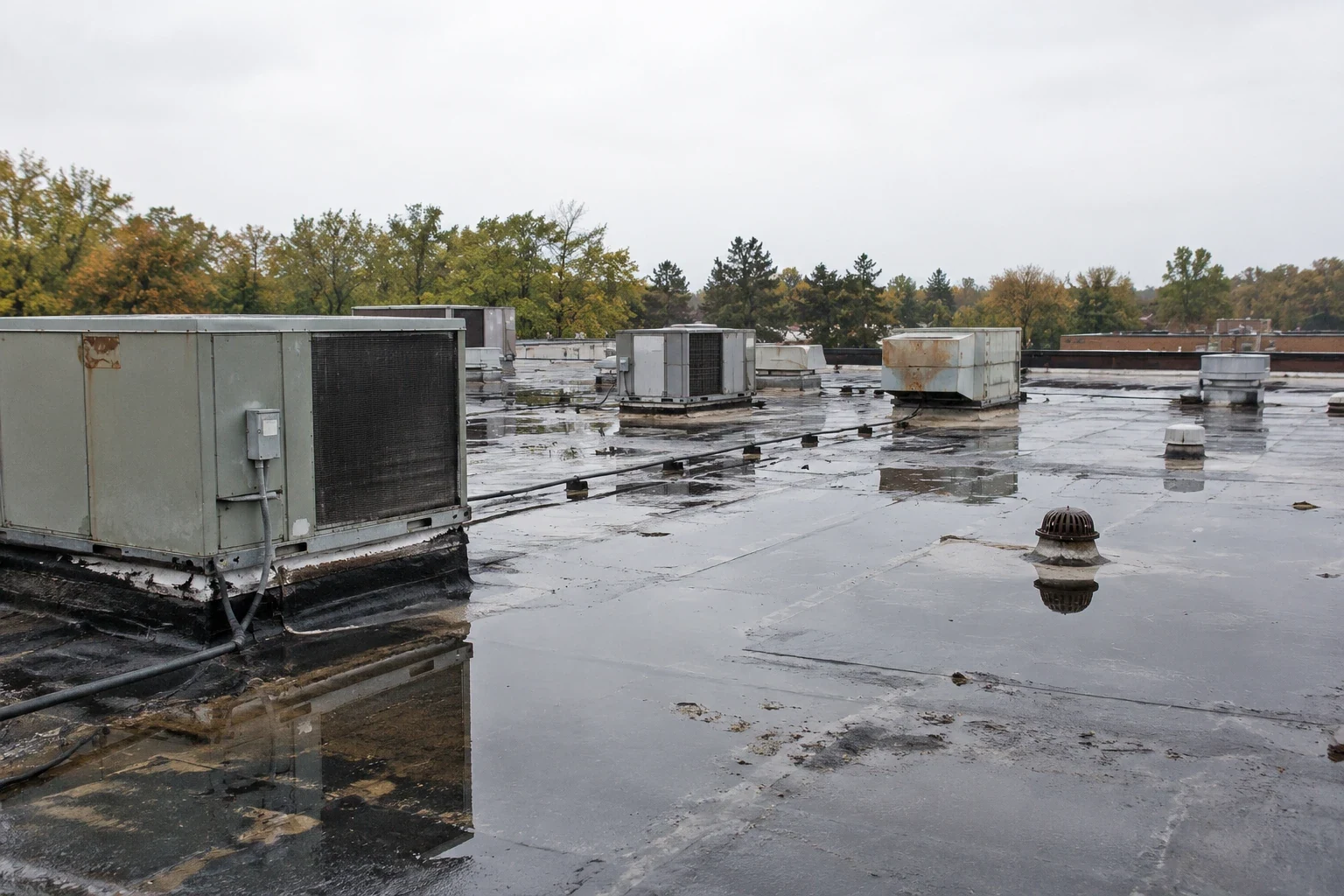
For that reason the drainage record is the first thing we build. We note where each slope sends water, whether drains and scuppers sit at the low points, and whether any area keeps water well after rain has stopped. Where ponding is persistent we say so plainly, because the repair may be a drain adjustment, tapered insulation, or a plan to replace the area rather than a patch. Our ponding water repair work starts from that written record.
Retail frontage and the inspection interval
Census QuickFacts reports 2022 retail sales of $216,343 thousand for Prairie Village, so commerce is part of the city's daily activity. A building with public customers and tenants who rely on a dry interior calls for a shorter gap between inspections, because a leak at the wrong moment costs more than the repair itself.
We recommend setting the inspection interval from the roof's condition, not from the calendar alone. A roof with clean seams, dry insulation and working drains can sit on a longer interval, while one with recurring repairs or standing water earns visits after the spring storm season and before the first freeze. Our preventive roof maintenance visits clear debris, reseal small defects, and add a dated line to the record each time.
Code edition and permit checks
Next door, Olathe adopted the 2018 code set on September 1, 2019. For a project in Prairie Village the owner and the building department confirm which edition and which local amendments apply before a bid basis is fixed, because insulation thickness, wind-uplift requirements and tear-off limits can all follow from the answer. We ask for the permit contact early so an insulation upgrade or a change in roof assembly does not surface as a surprise after pricing.
Existing-building rules sometimes limit how many roof layers a building may carry, and they may require insulation to be brought up to a current value when a roof is replaced. Those are scope questions with budget effects, so we raise them during the walk and carry them in the scope version, listing which items are required, which are options, and which depend on a code official's reading.
Choosing between repair, recover and replacement
A repair is the right answer when damage is local, the surrounding membrane is dry and well attached, and the cost of repeated visits is still lower than the carrying cost of replacement. A recover suits a sound, dry roof where an owner wants a new surface without tear-off. Replacement is the plan when moisture has traveled through the insulation, the deck is compromised, or defects keep returning faster than the repair budget can follow.
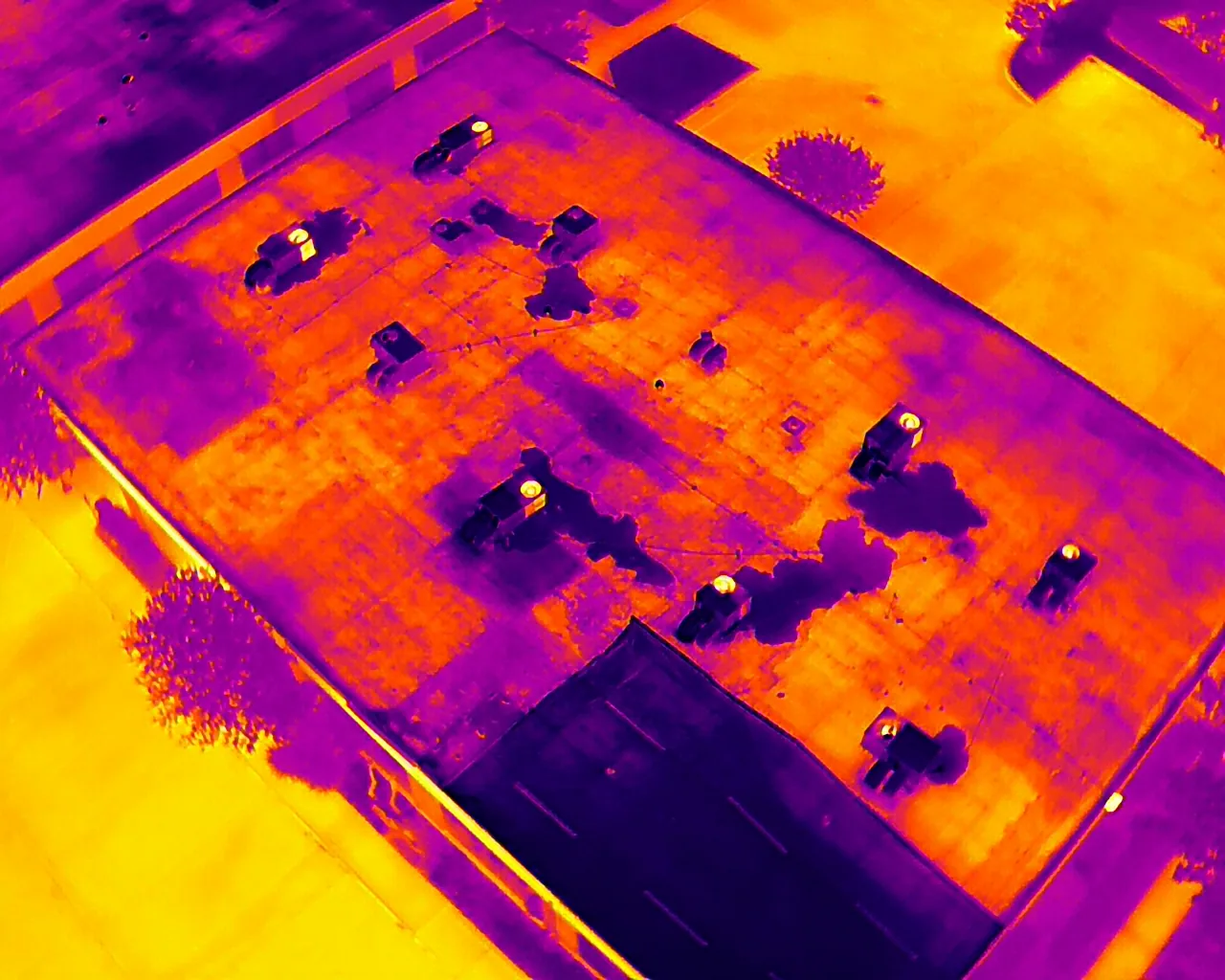
An infrared moisture survey and a few core samples remove most of the uncertainty between those paths. They show whether insulation is wet, how large the affected area is, and whether a recover would trap moisture. With that evidence the owner can compare options on one bid basis and choose by capital year and tenant schedule, not by guesswork. For membranes, PVC and TPO suit many low-slope buildings, while modified bitumen and built-up suit others, and the field condition guides the pick.
More About Commercial Roofing in Prairie Village, KS
Wind events, hail and tenant schedules
Surveyors followed the May 19, 2024 storm line along Gardner and Olathe at roughly 80 mph and logged several brief tornadoes elsewhere in Johnson County. Prairie Village is not in the reported path, so the survey triggers an inspection only for a property an owner has reason to place inside it. Hail belongs to Kansas City-area storms as well, and we judge an individual roof on what is visible: displaced edge metal, torn flashing, bruised or punctured membrane.
When work is needed, we schedule around the tenant. Interior protection, noise limits, parking and delivery access all go into the plan, and crews stage materials where they do not block fire lanes or customer routes. Active leaks get emergency roof repair at any hour, with the temporary work recorded separately. An owner with buildings in Overland Park or Olathe can schedule them together.
Before the first visit, it helps to decide who will receive the report and what they will do with it. A reserve schedule needs the ranked list and cost drivers, a lender may need the condition summary and photographs, and a tenant may need only the repair dates. Naming the readers up front lets the findings be arranged for each, with one underlying record.
Owners should also note any earlier roof work, even if the paperwork is lost. A patched corner, a replaced unit curb or a coating applied years ago changes how the surrounding membrane behaves, and a note from the maintenance supervisor can save a day of exploratory probing.
Finally, tell us about the tenant mix. A dental office, a restaurant and a law firm tolerate noise, odor and interior access very differently, and those differences decide the hours and sequence of any repair that follows the first report.
Commercial Roofing Questions
Which of my Prairie Village roofs should be inspected first?
Start with the roofs that have the most recurring repairs, visible ponding, or a tenant whose operations depend on a dry interior. Next come roofs approaching the end of an expected service life. A short survey of all buildings, followed by a ranked list, lets the owner commit capital where the field condition is weakest.
Should I wait for the code edition to be confirmed before asking for a bid?
Ask for the bid at the same time you confirm the code edition, and require the scope version to list the code-dependent items separately. That way a change in insulation or wind-uplift requirements shows up as a defined adjustment instead of an open-ended change order.
Can a roof recover be done on a building with active tenants?
A recover is often the lower-disruption path, since it avoids tear-off debris and shortens the time the roof is open. It is only suitable over a dry, sound existing system, so we verify with infrared imaging or cores first. Work is phased by section with interior protection where needed.
What does a written roof condition report include?
Dated photographs, a marked roof plan, notes on membrane, seams, flashing, drains and penetrations, moisture findings where tested, and a ranked list of recommended actions with timing. Repairs are separated from renewal items, so the report can feed a reserve plan directly.
Does the 2024 wind survey mean my roof needs replacing?
No. The survey documents wind effects along a specific path, and it calls for an inspection of any property that may sit within that path. Replacement follows only when the inspection finds damage or wear that cannot be corrected by repair.

Share the property list and the replacement window
Send roof plans, available reports, leak history, the decision date and an access contact for your Prairie Village buildings. We will return a documented assessment that keeps current repairs apart from capital planning assumptions.