
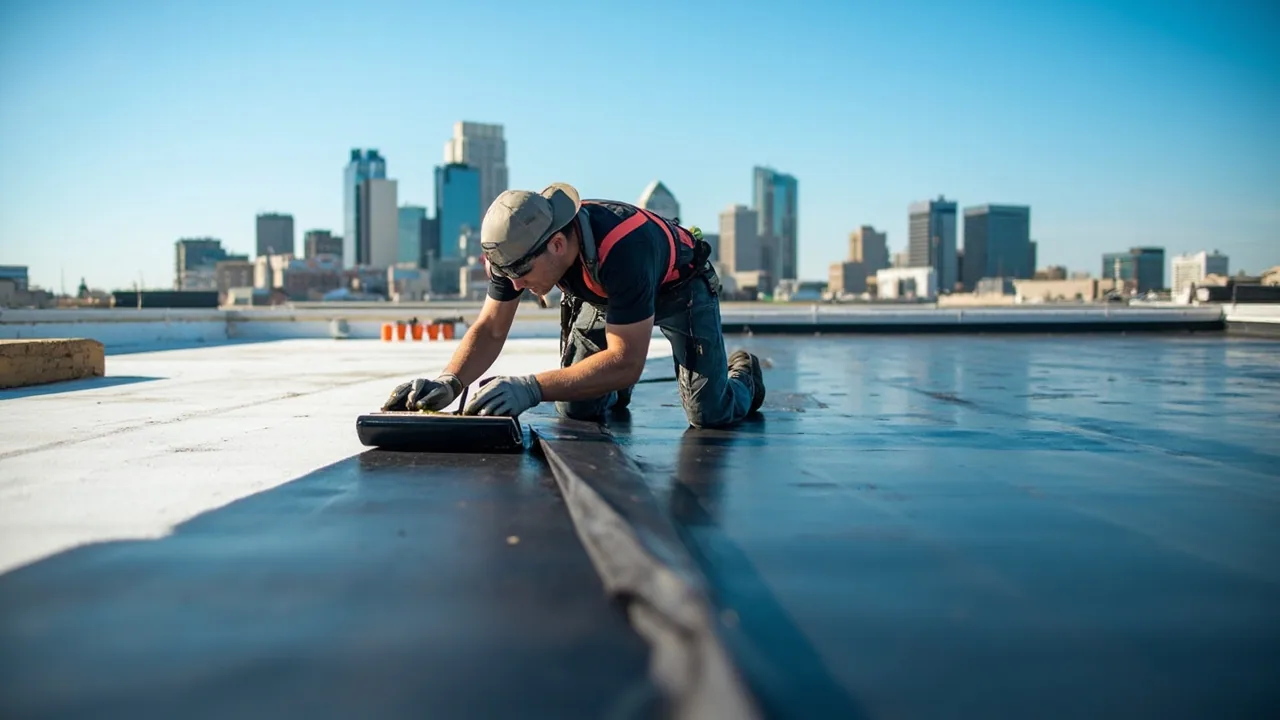
EPDM Roofing in Olathe, KS
An EPDM roof often reaches its decision point in a quiet year, when the sheet is still pliable in the field but the seams, the flashings and the ballast have started to tell a different story. The planning question for an owner in Olathe, KS is which of those three conditions sets the renewal date, and the answer comes from the roof-area register and not from the age of the sheet alone. At the airport station the mean runs from 29.8°F in January to 78.8°F in July and the year logs 109.6 freezing days, which keeps a rubber membrane moving with its seams and flashing details under tension. We walk the roof, mark what is moving, and set the next inspection interval around the risk that remains.
Send the roof-area register, the seam history and the access contact
Share prior reports, ballast or attachment details and the replacement window under review. We will document the EPDM sheet, seams and flashings and separate current repairs from capital assumptions.
What EPDM is, and how it is held down
EPDM is a synthetic rubber membrane supplied in large sheets, black or white, laid over insulation and a cover board or directly over a suitable deck. It stays flexible at low temperatures, which is why it has a long history on low-slope roofs in cold climates. Three methods hold it in place: loose-laid with ballast stone, fully adhered with bonding adhesive, and mechanically attached with fasteners and plates in the seams.
The attachment method sets the failure pattern. Ballasted roofs carry the weight of stone, so the deck and structure have to be able to support it, and wind can displace stone near edges if the edge treatment is weak. Adhered roofs depend on the quality of the bond and the cleanliness of the substrate, and fastened roofs depend on plate and fastener condition. Seams are joined with tape or liquid adhesive, not by welding, and they are the part of an EPDM roof that deserves the most attention over time.
Thickness and color affect cost and performance. Heavier sheets tolerate foot traffic and punctures better, and white sheets reduce heat gain but carry a cleaning requirement. Because the sheet is a thermoset rubber, it cannot be heat-welded, so a repair always uses adhesive, tape or a cured patch, and the preparation of the old surface decides whether the new bond lasts. We clean, prime and test each repair area before applying a patch.
Seams, shrinkage and flashing pull
Older EPDM sheets can shrink slightly as they age, pulling at the flashing where the membrane meets a wall or a curb. The first sign is a bridged corner or a base flashing that has lifted from the wall, and water finds the gap long before the field of the sheet shows anything wrong. Seam tape can fail where the surface was dirty at installation, and the seam edge is a visible line a technician can probe with a gentle tool.
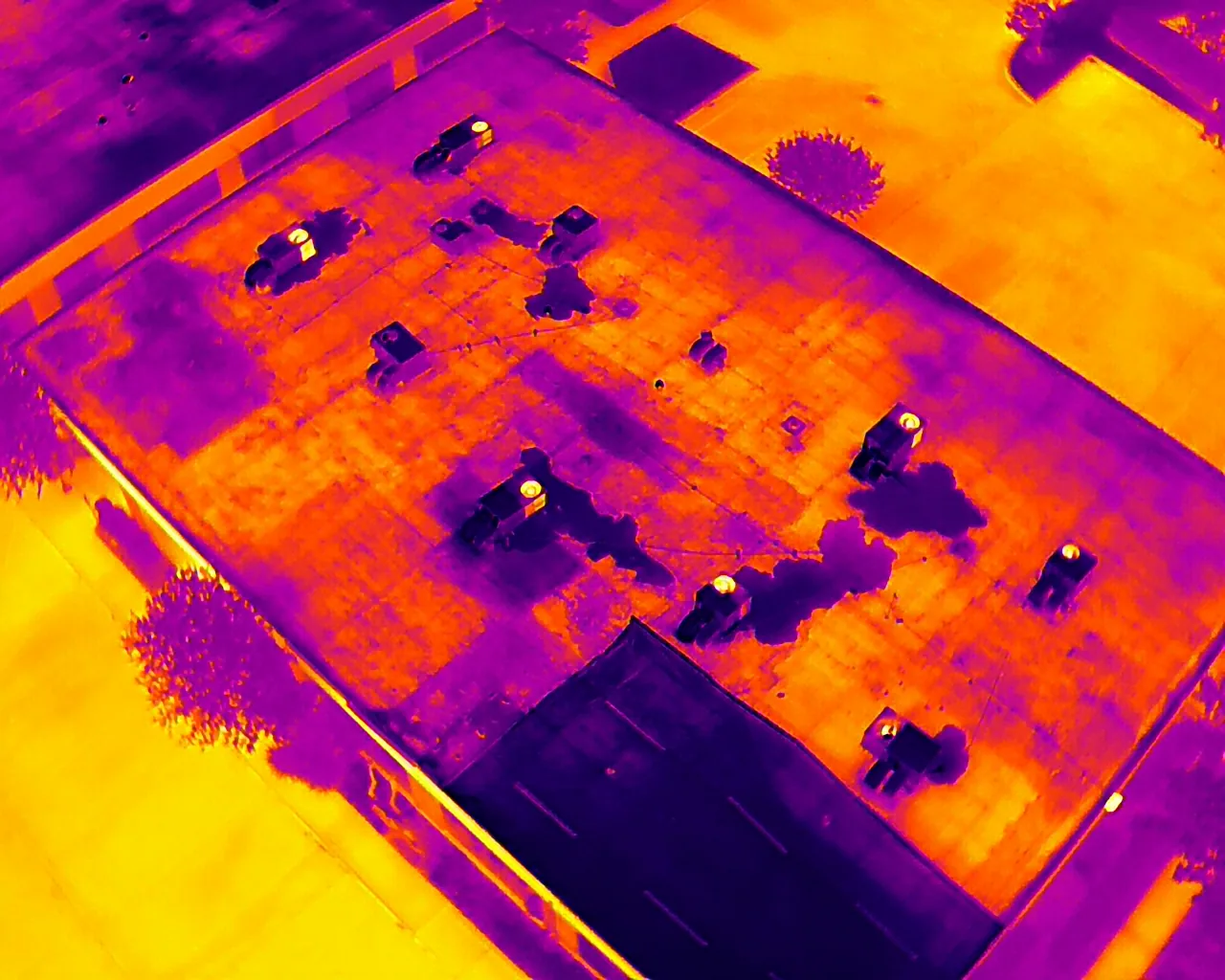
We inspect each seam type, check the splice cover strips at T-joints, look at walk-path wear, and test any questionable lap. Where the roof carries heavy equipment, we look for punctures, because rubber is tough against weather but less tolerant of dropped tools and sharp debris. An infrared moisture survey is useful on ballasted roofs, where stone hides the surface and wet insulation can sit under a sound-looking sheet.
Drains deserve a separate walk. A rubber sheet is clamped into the drain bowl, and a loose clamp ring or a cracked bowl leaks without any damage to the field. We lift debris from every outlet, check ring bolts and note any drain that sits above the surrounding surface, because a drain with a high lip leaves a permanent pond.

Freeze days, hail and the ballast question
Annual precipitation of 37.54 inches at the airport station, together with 109.6 freeze days, puts a rubber roof through repeated freeze-thaw cycles that test the drains and the seams. Water that freezes in a low area adds weight and stress, and ice along an edge can lift tape or pry at cover strips. We map low areas in the drainage record because a ponded section is both a leak risk and a future seam failure.
Severe thunderstorms across the Kansas City area can bring hail, and the useful response is an event inspection. EPDM tends to show hail as small bruises, and ballast can protect the sheet beneath it, but only an inspection after a reported event will show whether a given roof was hit. The straight-line winds of May 19, 2024 are the specific trigger for ballasted roofs along the Gardner-to-Olathe path, where the survey estimated gusts near 80 mph. We check stone displacement at perimeters and corners, and we look at the edge metal that holds the sheet in place. Bruises and punctures found after a storm are handled as hail damage repair, with each dent mapped to a roof section.
Repair, recover or replace an aging rubber roof
Many EPDM roofs can be maintained by resealing seams, replacing damaged flashings and patching punctures, provided the insulation is dry. When the sheet is sound but shrinking at details, new flashing and cover strips can extend its life. A recover installs a second membrane over the first when the existing assembly is dry; it avoids tear-off cost, but it adds weight and hides the old layers, so core samples come first. Our roof recover service is limited to roofs that pass that test.
Replacement becomes the better choice when moisture is widespread, when the sheet has become brittle at edges or when ballast removal and reinstallation make the repair nearly as expensive as a new roof. In that case an owner may move to a welded system such as TPO or a fully adhered EPDM with lighter weight, and some owners compare modified bitumen where foot traffic is heavy. The decision belongs in the capital plan with a stated bid basis and a dated scope version.
More About EPDM Roofing in Olathe, KS
Timing the work around adhesives and ground conditions
Adhesives and seam products have temperature and moisture limits, and cold or damp conditions can ruin a bond that looks fine on the day. For that reason the active replacement window for EPDM falls in spring through fall. Ballasted roofs add logistics: stone has to be removed, stored, cleaned and returned, or replaced with new stone, and the truck access and ground bearing affect the sequence.
The city's economic plan points to large industrial development in southern Olathe, naming Lineage Logistics, FedEx and the Lone Elm and 56 Commerce Centers. In that kind of large-scale setting, truck access and tenant schedules shape a roof project. Owners should align the install with their own tenant schedule and the city's current adoption, the 2018 International family of codes, confirmed with the city for each project.
Commercial Roofing Questions
What decides whether ballast stays on the roof?
The structure's capacity, the wind exposure at edges and the condition of the sheet beneath. If the deck cannot carry the stone or if the edges have lost stone in past storms, a fully adhered or mechanically attached system is the likely replacement.
How can an owner tell shrinkage from a normal seam?
Look for flashing that has pulled away from the wall, a membrane that bridges inside corners, or exposed fastener plates at the edge. These are field signs that the sheet is under tension, and they belong in the register with photographs.
Can EPDM be repaired in cold weather?
Temporary repairs can be made with cold-applied patches and sealant. Permanent seam work waits for conditions where adhesive and tape will bond, and the temporary repair is recorded with its limits.
Does a white EPDM change the maintenance plan?
It adds a cleaning interval because dirt shows and can reduce reflectivity. The seam, flashing and drain inspection interval stays the same.
How does the 2024 wind event apply to a ballasted roof?
For roofs in the reported Gardner-to-Olathe path, we check stone movement, edge metal and flashing for displacement. For roofs outside it, a normal inspection interval applies.
Send the roof-area register, the seam history and the access contact
Share prior reports, ballast or attachment details and the replacement window under review. We will document the EPDM sheet, seams and flashings and separate current repairs from capital assumptions.
